



DFI’s Sustainability Committee continues working with the European Federation of Foundation Contractors’ (EFFC) Sustainability Working Group to develop a series of guides addressing the U.N. Sustainable Development Goals (SDGs) that are most relevant to the geoindustry.
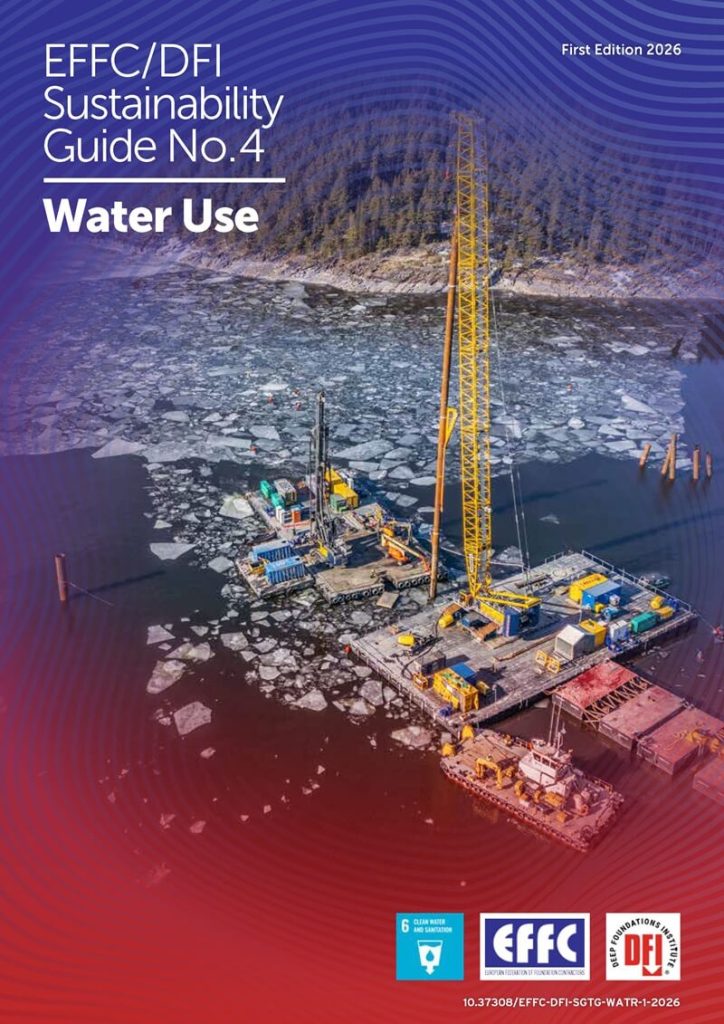
The latest guide, EFFC/DFI Sustainability Guide No. 4: Water Use, provides a structured, practice-oriented framework to help geotechnical contractors, designers and project stakeholders to reduce water consumption and manage water-related impacts in alignment with SDG 6 (Clean Water and Sanitation).
“Although we all know that water is a precious resource, it can be difficult in the geotechnical industry to know how to address our consumption and our impacts on the water cycle,” says Kimberly Martin, Ph.D., P.E., ENV SP, Keller North America, and co-chair of the EFFC/DFI Sustainability Guides Task Group. “Thanks to Alice Liddell, environmental sustainability manager at Sizewell C, for leading the team that brought us the Water Guide, which helps us address this challenge in a practical way.”
Recognizing freshwater scarcity, climate-driven hydrological stress and increasing regulatory and client expectations, the guide addresses these across the geotechnical project lifecycle.
Using a “what–why–how–measure” methodology, the guide characterizes how ground engineering activities interact with surface water, groundwater and supply chains. It highlights the variability of water demand across geotechnical solutions and emphasizes the importance of reducing the use of water through design choices such as nature-based solutions.
Sustainability Guides No. 1, No. 2 and No. 3
The first guide in the series, EFFC/DFI Sustainability Guide No. 1: Carbon Reduction, addresses SDGs 13 (Climate Action) and 7 (Renewable and Clean Energy).
The second guide in the series, EFFC/DFI Sustainability Guide No. 2: Circular Economy, focuses on SDG 12 (Responsible Consumption and Production).
The third guide, EFFC/DFI Sustainability Guide No. 3: Climate Adaptation & Resilience, addresses SDGs 11 (Sustainable Cities and Communities) and 13 (Climate Action).
The guides are not minimum requirements or sector standards, but rather practical support guides sharing good practice. The guides are free and can be downloaded from the DFI Publications Store.